
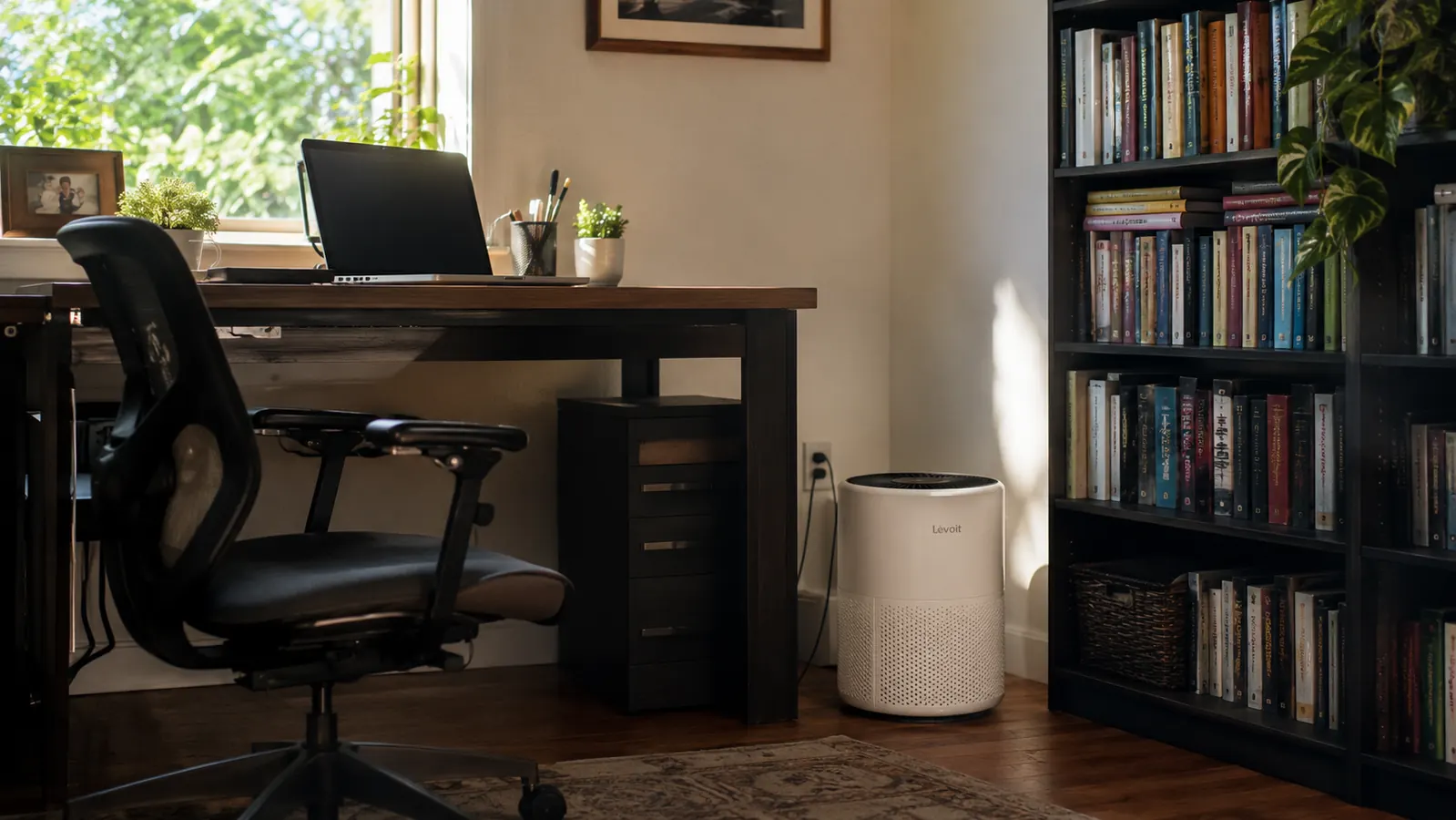
My home office is a converted spare bedroom with one window that doesn't open more than four inches, a rescue dog named Biscuit who sheds like it's his job, and a house that was built in 1974 and has the duct system to prove it. By last December I'd stopped noticing that the room smelled faintly like dust and old carpet until a friend came over for coffee and asked, half-joking, if I'd ever thought about opening a window in there. That was the nudge. I ordered the LEVOIT air purifier the same week, the model rated for spaces up to 1,073 square feet, mostly because I figured if it could handle a space four times the size of my office, it wouldn't be working hard just to keep up. It arrived on a Tuesday, and I had it plugged in and running behind my desk chair before I'd even broken down the box.
Six months later, I still run it every day I work from home, which is most of them. This isn't a first-impressions post. It's what changed after 26 weeks of the same purifier running behind my desk chair, through pollen season, through a stretch of wildfire smoke that turned the sky orange for three days, and through Biscuit's spring shed that leaves fur on everything including, apparently, my coffee mug. I wanted to write this after enough time had passed that the newness had worn off and I could tell whether it was actually doing something or whether I'd just talked myself into liking it because I'd spent money on it.
The Quick Verdict
Six months in, it's the one piece of home office gear I'd replace within the week if it broke. Quiet enough to forget about, strong enough that I actually notice the difference when it's off.
Amazon Check Today's Price →Still working in a room that smells like it needs an open window?
A stuffy office isn't just unpleasant, it's the kind of low-grade distraction that makes a four-hour focus block feel like six. Check today's price on the LEVOIT air purifier and see if it's still in stock for your space.
Amazon Check Today's Price on Amazon →How I've Used It
I set the purifier up on the floor to the left of my desk, about three feet from where I sit, angled so the air intake faces the middle of the room instead of the wall. That placement matters more than I expected. The first week I had it tucked in a corner behind a filing cabinet, and while it still ran, it felt like it was cleaning the corner rather than the room. Moving it out where it could actually pull air from the space I sit in made a noticeable difference within a couple of days, and it's stayed in that same open spot ever since.
For the first month I ran it on the automatic setting, which uses the built-in air quality sensor to ramp the fan up or down depending on what it detects. I liked this in theory, but in practice I found myself second-guessing whether it was actually doing anything, since the display just shows a color and a number rather than plain language. Somewhere around week five I switched to running it on the sleep setting during work hours and only bumping it to a higher speed when I noticed something specific, like after vacuuming or when Biscuit had just come in from rolling around outside.
That's been my routine ever since. Low and steady most of the day, a boost after anything that kicks dust into the air, and off overnight since my office door stays closed anyway. Over six months, that comes out to somewhere around 1,800 hours of runtime, which is enough to actually see what the filter looks like when it's earned its keep, and enough to know the routine isn't going to change much going forward.
What the HEPA Filter Actually Traps
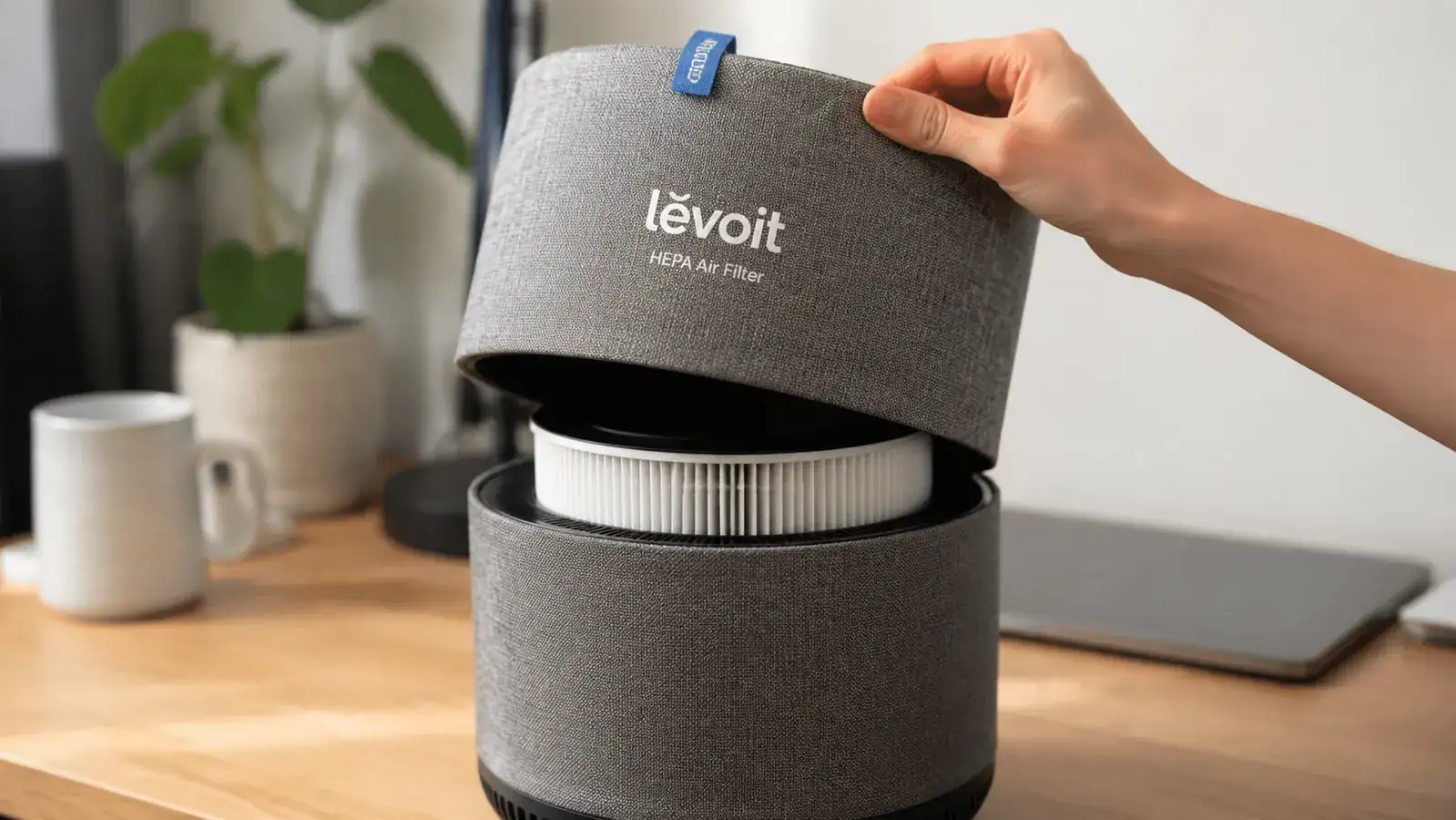
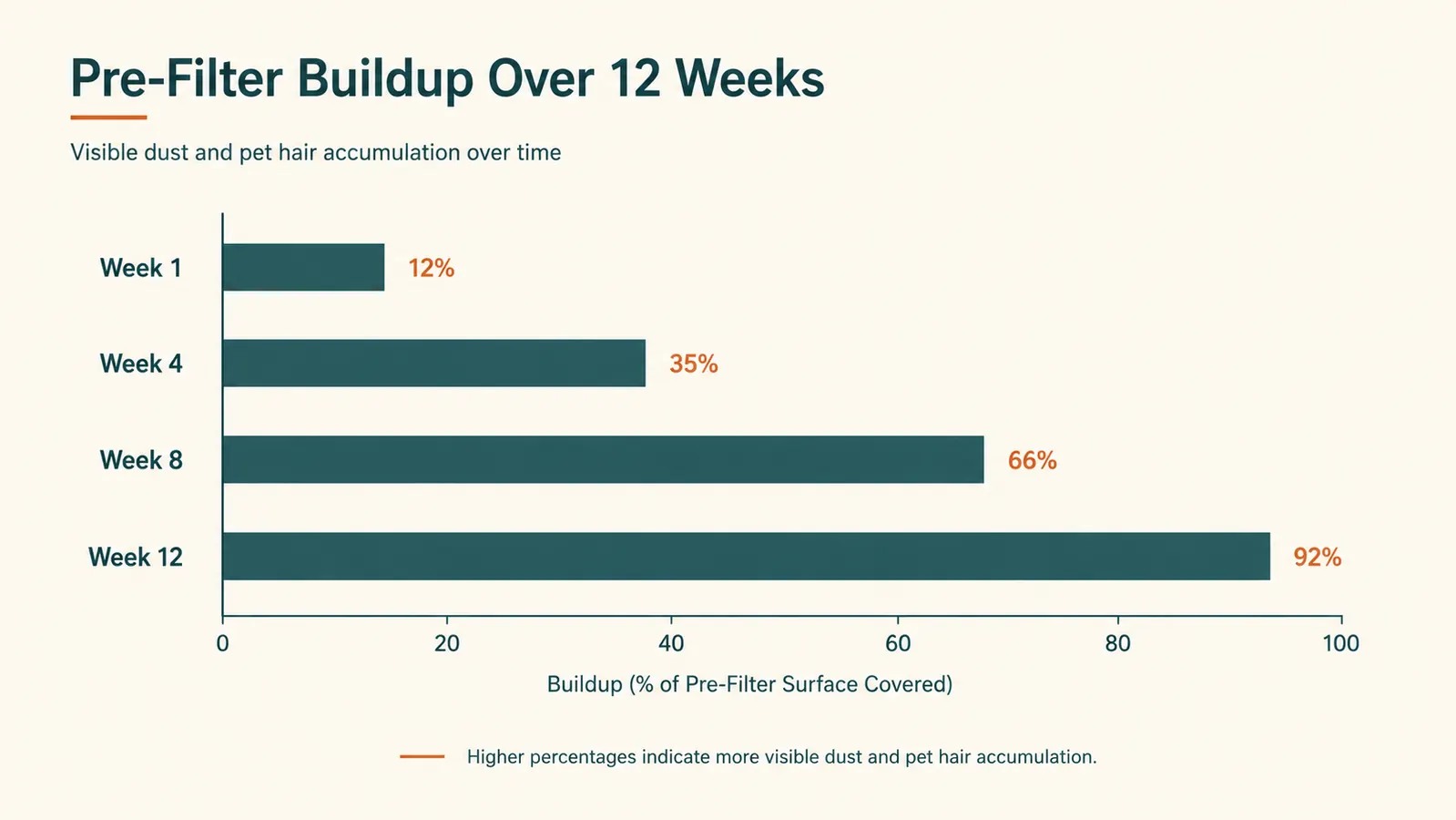
I'll be honest, I did not expect to be writing a paragraph about a filter, but here we are. Around week six I pulled the fabric pre-filter cover off to wipe it down, something LEVOIT recommends doing every two to four weeks, and the amount of gray fuzz and dog hair caught on it was genuinely surprising. Not gross exactly, just a visual reminder that all of that had been floating around my office air before it ended up there instead of in my lungs or on my keyboard. I started wiping it down every other Sunday after that, which takes maybe two minutes with a vacuum brush attachment.
The pre-filter catches the big stuff, hair, dust, lint. The actual HEPA filter underneath is what's rated to capture the smaller particles, down to 0.3 microns according to the listing, which covers most pollen, mold spores, and a good chunk of what makes wildfire smoke smell the way it does. I can't independently verify a lab-grade micron count from my kitchen table, but I can tell you that during the three smoky days in September, running the purifier on a higher setting noticeably cut the burnt, hazy smell in my office compared to the rest of the house, which still smelled like it outside every time I opened the office door.
The one thing I didn't love was how opaque the filter replacement indicator is. It's a light that comes on, not a percentage or a countdown, so for the first few months I had no real sense of how close I was to needing a new one. I ended up marking my calendar at the four-month point as a manual reminder rather than trusting the light to tell me in time, which feels like a workaround I shouldn't have had to build myself.
Noise Level Through a Full Workday
This mattered more to me than I expected going in. I take video calls most days, sometimes back to back, and the last thing I wanted was a coworker asking if I'd left a fan running in the background. On the lowest setting, the purifier is close to silent, quiet enough that I genuinely forget it's on until I catch the faint glow of the display out of the corner of my eye. On sleep mode, which is what I run most of the day, it's a soft, even hum that's easy to talk over on a call, and in six months no one on a Zoom call has ever asked what that noise was.
Turn it up to the higher speeds and it's a different story. Speed four and five have a noticeable whoosh that would absolutely show up on a Zoom mic, so I only use those settings when I'm not on a call, usually right after I've been cleaning or when Biscuit's been particularly enthusiastic about rolling in the yard. For a typical workday of writing, calls, and admin, I'd say it stays on the low end about 80 percent of the time, with the higher speeds reserved for maybe twenty minutes total most days.
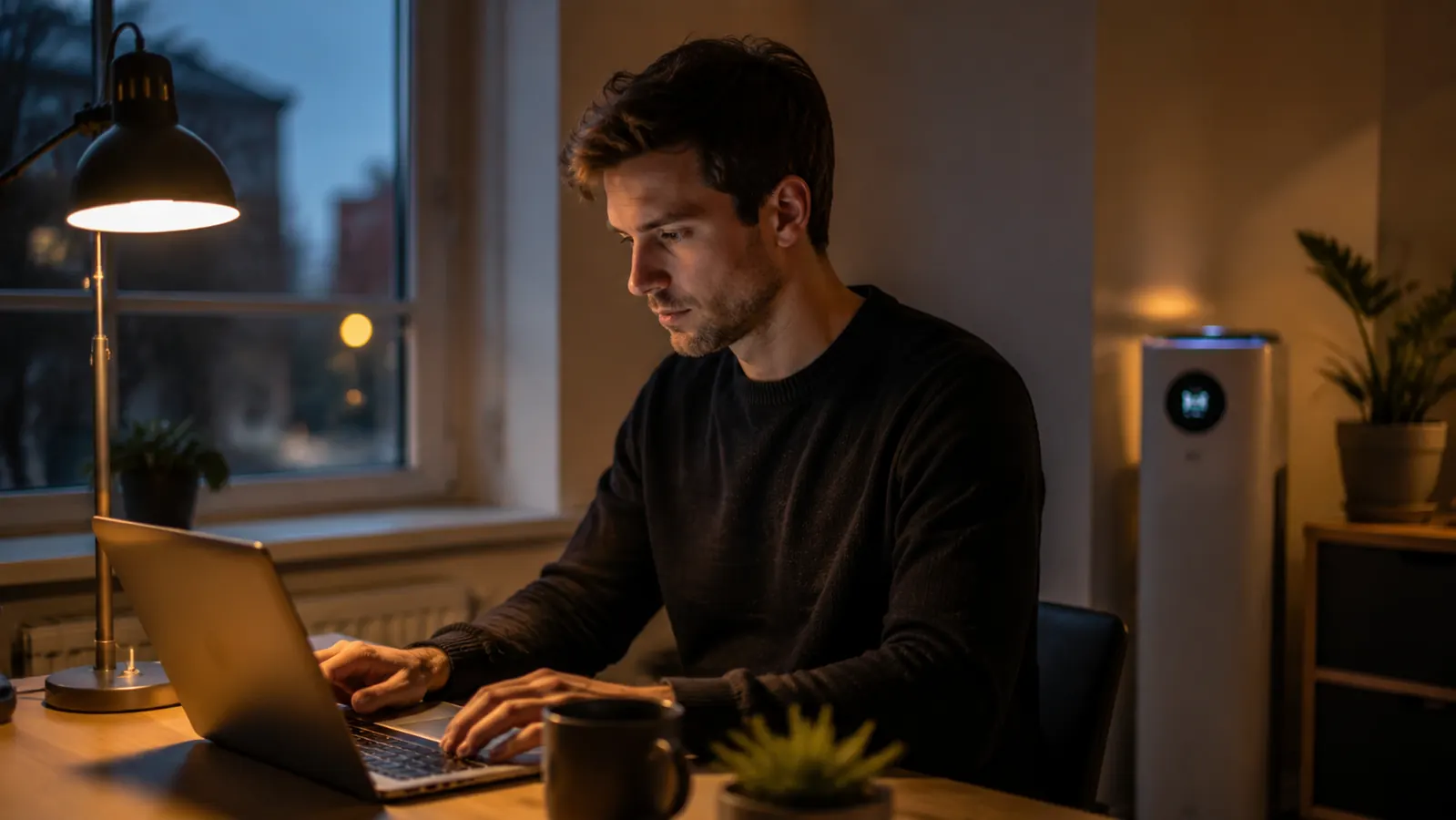
The other small thing worth mentioning is the display itself. There's a night light setting that dims the screen, which I appreciate since my desk faces the purifier and a bright display glowing all day would have driven me a little crazy. I keep it dimmed and barely notice it anymore, even during late evening work sessions when the rest of the room is dark.
Coverage in a Real Home Office, Not a Marketing Spec
My office is roughly 140 square feet, nowhere close to the 1,073 square foot rating on the box. I chose to size up on purpose, mostly on the logic that an air purifier working well within its rated capacity will cycle the air in a small room faster and run quieter doing it than one that's maxed out. Six months in, I think that logic held up. On the low setting in my small room, I can tell the air has visibly turned over within about 20 to 30 minutes of closing the door and running it, based on how quickly a candle scent or cooking smell from the kitchen down the hall clears out.
If your home office is closer to 300 or 400 square feet, an open loft area or a converted garage, I'd still expect solid performance, just don't expect the same near-instant clearing I get in a tighter room. Bigger open spaces with more air exchange points, doorways, stairwells, will always be a harder job for any single unit regardless of the square footage rating on the box, so sizing up from your actual room size is worth the extra thought before you buy.
The other factor nobody puts on the packaging is furniture and airflow blockers. My office has a bookshelf and a filing cabinet that create a bit of a dead zone in one corner. Moving the purifier so it has open floor space around the intake made a bigger practical difference than anything else I tried, more than the fan speed setting did most days, which is worth experimenting with before assuming a unit isn't working hard enough.
Where It Falls Short
Six months of daily use surfaces the annoyances that a first-week review can't catch. The biggest one for me is the filter replacement indicator light I mentioned earlier. It's not clearly explained in the manual, and the first time it lit up I genuinely wasn't sure if it meant replace now or replace soon. I'd rather have a percentage readout or a simple countdown, the way some higher-end models do, and I hope a future version addresses it.
The second thing is the auto mode's sensitivity. I found it ramps the fan speed up more aggressively than I expected in response to things that don't feel like they should matter much, like opening the office door for a few seconds to let Biscuit in. It's a minor thing, and it stopped bothering me once I switched to manual sleep mode, but it's worth knowing going in if you're hoping to set it and fully forget it rather than adjust it yourself.
Replacement filters are also a recurring cost worth planning for. LEVOIT recommends swapping the HEPA filter roughly every six to eight months depending on use, so this isn't a buy-it-once purchase. It's closer to a printer, where the ongoing filter cost is part of the real picture, not just the unit price, and it's worth budgeting for before you decide the purifier itself was a bargain.
What I Liked
- Genuinely quiet on the low and sleep settings, safe for video calls
- Noticeably reduced the stale, dusty smell in my office within the first two weeks
- Clears air fast in a small to mid-size room based on how quickly odors dissipate
- Dimmable display doesn't glow distractingly at a desk
- Handled wildfire smoke smell better than I expected during a three-day smoke event
Where It Falls Short
- Filter replacement indicator is vague, just a light with no percentage or countdown
- Auto mode ramps the fan speed up more aggressively than seems necessary
- Higher fan speeds are noticeably audible over a video call mic
- Ongoing filter replacement cost every six to eight months adds up over time
I didn't expect a filter to change how a workday feels, but the difference between a stuffy office and one that just smells like nothing at all is bigger than I gave it credit for.
Who This Is For
If your home office doubles as a room that collects dust, pet hair, or the occasional whiff of whatever's cooking down the hall, this is worth the desk space. It's also a solid pick if you deal with seasonal allergies and want your workspace to be the one room in the house where your eyes and sinuses get a break, or if you live somewhere that gets wildfire smoke or heavy pollen for part of the year and want a real buffer against it while you're trying to concentrate.
Who Should Skip It
If your office already has strong airflow, a window that actually opens, or a whole-home air filtration system you trust, you may not notice enough of a difference to justify the counter space it takes up. It's also not the right pick if you're hoping for a silent-at-every-speed unit for a very small room, since the higher fan settings are audible enough that you'll want to reserve them for times you're not on a call.
Your workspace should be the easiest room in the house to breathe in.
Six months in, this is still the piece of home office gear I'd reorder without thinking twice. See today's price and current availability for the LEVOIT air purifier before you settle for another season of a stuffy office.
Amazon Check Today's Price on Amazon →